





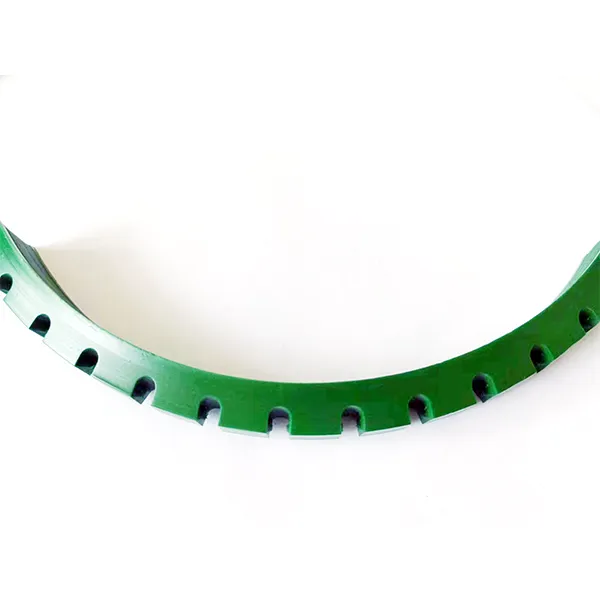
PU PVC Conveyor Belt with Toothed Guide Profile
SHUNNAI PU PVC Conveyor Belt with Toothed Guide Profile is designed for curved conveying systems that require reliable belt guidance and controlled bending. Available with square, trapezoidal, round, V-shaped, and dovetail guide profiles, it helps accommodate the changing geometry of 90° and 180° conveyor curves while reducing stress concentration at the guide root.
Eliminate Extrusion Stress
No Shape Limitation – Any Cross-Section Can Be Toothed
Rigid-Flexible Combined Anti-Misalignment Solution for Curves
No Shape Limitation – Any Cross-Section Can Be Toothed
Rigid-Flexible Combined Anti-Misalignment Solution for Curves
A PU PVC Conveyor Belt with Toothed Guide Profile combines a flexible toothed guide with a compatible conveyor belt to help maintain lateral tracking when the belt follows a curved route. The notches along the guide allow controlled deformation as the belt moves through a bend, reducing the stress that can develop when a solid guide is forced around a curve.
SHUNNAI offers guide profiles in different cross-sections, including square, trapezoidal, round, V-shaped, and dovetail designs. Depending on the belt material and operating environment, the guide can be manufactured from suitable polyurethane (PU) or polyvinyl chloride (PVC) materials and attached using an appropriate hot-vulcanizing or high-frequency welding process.
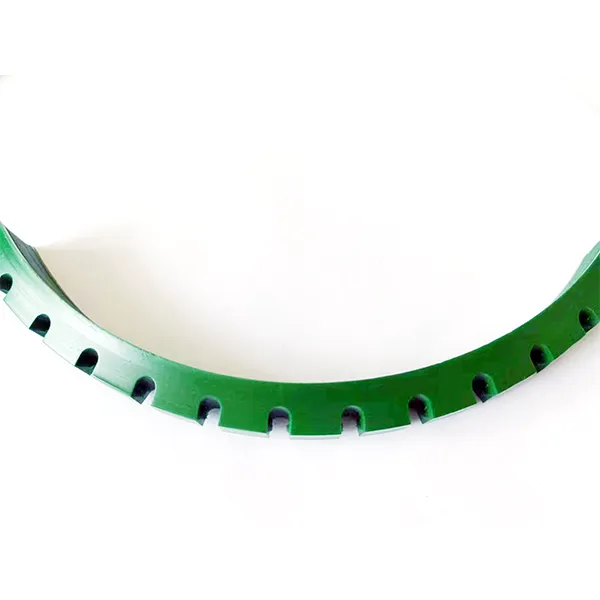
How the Guide Follows a Curve
A curved conveyor creates different travel distances between the inner and outer sides of the belt. A rigid, continuous guide may resist this change, increasing pressure at the guide root and potentially causing cracking, separation, or tracking problems.
Toothing introduces regularly spaced gaps along the guide, allowing the profile to accommodate bending more easily. The gaps open or compress as the guide follows the curve, helping distribute deformation rather than concentrating all the stress at one point. This design can reduce the risk of guide damage when the profile and tooth pattern are matched to the conveyor geometry.
Toothing is a manufacturing process rather than a specific cross-sectional shape. Square, trapezoidal, round, V-shaped, and dovetail guides can all be toothed. The correct combination depends on the guide rail, curve radius, required lateral restraint, belt construction, and conveyed material.
Select the Right Profile Shape
Square Profile
A square guide provides flat side walls for lateral restraint. A toothed square profile may suit curved conveying sections where maintaining the belt's position within the guide channel is a priority.
Trapezoidal Profile
The wider base provides a broad bonding area, while the toothed section allows the guide to bend along the curve. This shape is worth evaluating when both attachment stability and bending flexibility are important.
Round Profile
A round guide has a smooth contact surface and can follow curved paths with relatively smooth bending. It may be considered for handling delicate or precision products, subject to the guide rail design and actual contact conditions.
V-Shaped Profile
A V-shaped guide works with a compatible V-groove or guide rail to support centering. The mating dimensions must be checked before ordering to ensure that the guide engages correctly without excessive friction.
Dovetail Profile
A dovetail profile mechanically engages with a matching channel. When toothed for curved applications, it can combine a secure profile fit with bending flexibility, provided the channel geometry and installation method are compatible.
SHUNNAI can assess the required profile based on drawings, samples, channel dimensions, and conveyor layout. A profile should not be selected by shape alone; the mounting method and operating conditions also affect performance.
Tooth Pitch and Curve Radius
Tooth pitch and tooth depth influence how readily a guide bends around a curve. A pattern designed for a large-radius bend may not provide enough flexibility for a tighter curve. Conversely, an unsuitable tooth pattern can weaken the guide or cause uneven contact during operation.
When evaluating a PU PVC Conveyor Belt with Toothed Guide Profile, buyers should provide the conveyor's minimum curve radius, guide cross-section, required guide height, and available installation space. SHUNNAI can use these details to assess a suitable tooth pattern rather than applying one standard design to every conveyor.
The final design should maintain enough material at the guide root for secure attachment while allowing the notched section to flex. The appropriate dimensions should be confirmed against the actual equipment geometry and expected operating cycle.
PU or PVC for Your Operating Conditions?
Material selection affects flexibility, wear behavior, chemical compatibility, and cleaning requirements. The correct option depends on the products being conveyed and the environment around the belt.
PU: Polyurethane may be considered for applications that require a flexible belt system and frequent cleaning. For food-related equipment, buyers should specify the intended food-contact conditions and request documentation confirming that the selected material and finished product meet the applicable requirements.
PVC: Polyvinyl chloride may be suitable for general conveying applications where its flexibility, surface properties, and operating-temperature range meet the equipment requirements. Chemical exposure, cleaning agents, and the minimum curve radius should be checked before selection.
SHUNNAI supplies conveyor belt and accessory solutions for different industrial requirements. The suitability of a particular PU or PVC compound must be confirmed for the actual application rather than assumed from the material name alone.
Attachment Methods and Inspection
A toothed guide needs a reliable connection to the belt. Depending on the belt construction and selected materials, SHUNNAI may use hot vulcanization or high-frequency welding. The suitable method depends on material compatibility, belt thickness, guide dimensions, and the equipment available for manufacturing.
Before installation, check that the bonding surface is clean and that the guide is positioned according to the conveyor drawing. After attachment, inspect the guide alignment, tooth consistency, bonding continuity, and profile dimensions. A trial run should confirm that the guide moves through the curve without binding or abnormal rubbing.
During routine maintenance, pay attention to cracks at the guide root, lifted bonding edges, worn contact surfaces, and debris trapped between the guide and rail. Early inspection can help identify a mismatch between the profile design and actual operating conditions.
Where Toothed Guides Are Used
Toothed guide profiles are mainly used on 90-degree and 180-degree curved belt conveyors where the belt must follow a defined path. They can also be considered for conveying systems with limited oscillating or changing-direction sections, provided the movement and load conditions are within the design limits.
Typical applications include food packaging lines, bakery conveying, fruit and vegetable handling, logistics sorting, and curved transfer sections. For wet or washdown environments, buyers should confirm the suitability of the selected material, attachment method, and cleaning procedure.
Toothed guides are not a universal solution for every tracking problem. Long straight conveyors with substantial off-center loading, strong lateral forces, excessive speed, or heavy contamination may require a different guide arrangement or additional conveyor design changes. The complete conveying system should be assessed before specifying the profile.
Customer Experience
Food Packaging Equipment, Guangdong
“Our curve line originally used round guides, and the belt kept wandering left and right. SHUNNAI made us round toothed guides – they have the smoothness of round guides, and the teeth bend along the curve. The belt no longer wanders. After more than half a year, the guide has not debonded.”
Logistics Sorting Center, Jiangsu
“The sorting line has many curves. The trapezoidal guides tore shortly after installation. SHUNNAI recommended trapezoidal toothed guides – the wide base bonds firmly, and the teeth can bend. After nearly a year, the teeth have not cracked and the guide has not fallen off.”
Bakery, Shandong
“The workshop is washed daily; debonding is the biggest fear for guides. SHUNNAI’s PU toothed guides are heat-fusion welded – water cannot wash them off. The square toothed side walls hold firmly, and bread stays centered through the curve. After more than half a year, the guide still has elasticity.”
What to Confirm Before Ordering
To help SHUNNAI recommend a suitable guide configuration, prepare the following information before requesting a quotation:
Conveyor layout: Specify whether the system uses a 90-degree curve, a 180-degree curve, or another curved arrangement. Provide the minimum curve radius and a drawing if available.
Guide dimensions: Confirm the cross-sectional shape, guide height and width, mounting position, and guide rail dimensions. A photo or physical sample can help clarify the existing design.
Belt and guide materials: Identify the belt material and thickness, and state whether PU or PVC is required. If the line handles food, include the intended product contact and cleaning conditions.
Operating conditions: Share conveying speed, product weight and dimensions, duty cycle, ambient temperature, moisture, cleaning chemicals, and any known tracking or guide failures.
Attachment requirements: Indicate whether hot vulcanization or high-frequency welding is preferred or required, and whether the guide will be supplied on a new belt or for an existing belt system.
These details help reduce the risk of choosing an incompatible profile or tooth pattern and support a more accurate quotation.
Frequently Asked Questions
Can a toothed guide be made from any profile shape?
Toothing can be applied to different base shapes, including square, trapezoidal, round, V-shaped, and dovetail profiles. The feasibility and final dimensions depend on the material, guide size, curve radius, and manufacturing process.
Will a toothed guide solve every belt-tracking problem?
No. It can help a guide follow a curved path with less deformation stress, but tracking also depends on belt alignment, pulley positioning, loading, tension, and guide rail geometry. The full conveyor should be checked if tracking remains unstable.
How do I choose the tooth pitch for a small-radius curve?
Provide the minimum curve radius, guide cross-section, guide dimensions, and operating conditions. Tooth pitch and depth should be evaluated against the actual geometry; a standard pattern should not be assumed suitable for every small-radius conveyor.
Can the guide be installed on an existing conveyor belt?
Possibly, depending on the belt material, condition, available bonding area, and compatibility with the selected attachment process. SHUNNAI should review the existing belt construction and installation requirements before confirming feasibility.
What information is needed for a food-processing application?
Specify the conveyed food or packaging, whether direct food contact occurs, cleaning frequency, cleaning chemicals, temperature, and washdown method. Request the applicable material and compliance documentation for the exact product configuration.
Work with SHUNNAI on Your Guide Design
Since 2007, SHUNNAI has supplied conveyor belts and accessories for industrial conveying applications. Our team can evaluate the profile shape, tooth pattern, belt material, and attachment method against your conveyor layout and operating conditions.
SHUNNAI maintains an ISO 9001 quality management system and has FDA-, MA-, and CNAS-related credentials. The scope and applicability of specific certifications or documents should be confirmed for the selected product, material, and intended use. For food-processing projects, buyers should verify the relevant food-contact requirements before purchase.
If you need a PU PVC Conveyor Belt with Toothed Guide Profile for a new curved conveyor or want to improve an existing line, send us your belt specifications, curve radius, guide dimensions, and application details. SHUNNAI can review the requirements and recommend a configuration for your project.
Contact SHUNNAI to discuss guide profile customization, belt compatibility, and quotation requirements.
Send Inquiry
Contact Info
-
Address
No.129 Qingfeng Road, Jizhou District, Tianjin City, China
-
Tel
-
Email
If you have any inquiry about a quotation or cooperation, please feel free to email or use the following inquiry form. Our sales representative will contact you within 24 hours.
News Recommendations



